
Direct answer
Why is PVA used in slime and sensory toys?
PVA dissolves in water and can form clear, continuous films and stable viscous solutions. In a properly designed finished formulation, these properties can support transparency, stretch, smooth handling and repeatable texture. The finished toy’s safety and performance, however, depend on the complete formulation and market-specific testing, not on PVA alone.
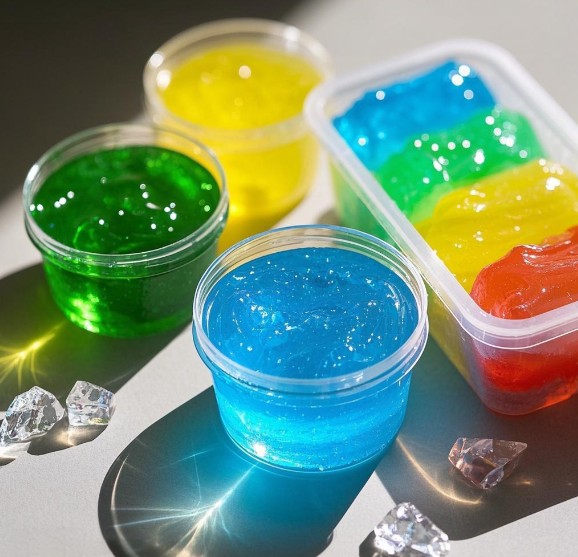
Clarity and color expression
A suitable PVA base can support transparent or translucent gels that display pigments, glitter and decorative elements clearly.
Viscosity and texture control
PVA grade, concentration and solution preparation influence base viscosity, flow, stretch and the consistency of production batches.
Water-based processing
PVA can be prepared in water, but dissolution temperature, mixing sequence, hygiene and preservation must be controlled in manufacturing.
Application scope
Toy and craft formats to evaluate
The source document identifies several product concepts. These should be treated as development categories rather than proof that every PVA grade or formulation is suitable for children.
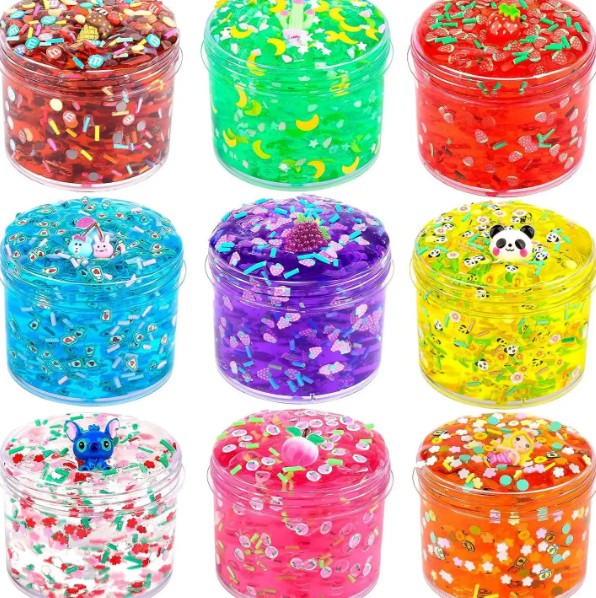
- Slime and sensory gels: clear, crystal, fluffy and other texture-led formats developed under controlled specifications.
- Water-based craft adhesives: school and hobby products where bond performance, washability and finished-product safety are verified.
- Soft fillings and squeeze toys: gel or dough-like filling systems assessed together with the outer shell, seams and leakage risk.
- DIY material kits: age-appropriate kits with controlled ingredients, clear instructions, warnings and adult-supervision requirements where applicable.
Material selection
What should manufacturers screen in a PVA grade?
Optical and sensory targets
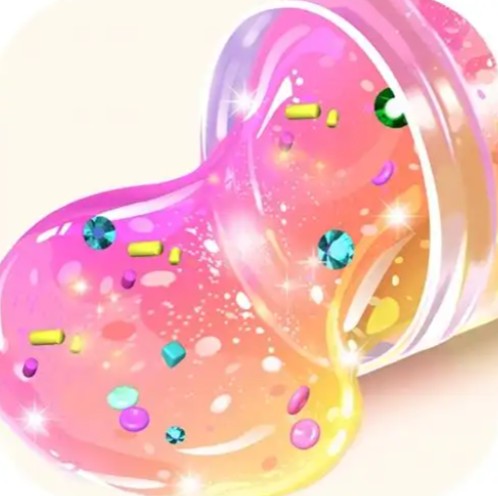
Review solution clarity, color compatibility, smoothness, residue, tack and the texture required after the complete gel system is formed.
Hydrolysis and viscosity
These grade characteristics affect dissolution behavior, solution viscosity and formulation response. Select them through bench trials rather than a universal recipe.
Manufacturing consistency
Define incoming-material controls, solution preparation, temperature, mixing time, filtration, microbial controls and batch acceptance criteria.
Safety and compliance
Finished-toy validation cannot stop at the raw material
A supplier’s PVA documentation supports raw-material review, but it does not certify the complete toy. Manufacturers and importers should define the intended age group, foreseeable use and target markets, then test the final packaged product through qualified laboratories.
- Chemical assessment: evaluate the full ingredient list, impurities, migration, preservatives, colorants, fragrances and crosslinking system.
- Physical assessment: consider leakage, small parts, packaging, container integrity, misuse and age grading.
- Claims and labeling: substantiate terms such as washable, non-toxic, biodegradable or hypoallergenic before use.
- Market compliance: confirm current testing, documentation, traceability and labeling obligations for every destination market.

Development workflow
A practical route from grade screening to market-ready toy
1. Define the product
Specify age group, toy format, texture, appearance, package, shelf life, use instructions and destination markets.
2. Screen candidate grades
Compare PVA grades for dissolution, clarity, viscosity and compatibility in controlled laboratory formulations.
3. Validate the full system
Test performance, microbial stability, migration, foreseeable use, packaging integrity and storage behavior.
4. Confirm compliance
Use current standards, accredited testing and market-specific technical documentation before commercial release.
Information for grade screening
What should you share with Joyforce?
| Information | Examples | Why it matters |
|---|---|---|
| Product and process | Slime, sensory gel, craft adhesive, filling; batch process and dissolution equipment | Helps screen solubility, viscosity and processing fit. |
| Performance targets | Clarity, flow, stretch, tack, residue, color and shelf life | Links grade screening to measurable finished-product targets. |
| Compliance needs | Destination markets, age grade, required supplier documents and restricted-substance criteria | Clarifies documentation needs without treating the raw material as finished-toy certification. |
Content audit
Important corrections to the source document
- Changed unconditional “safe and non-toxic” wording to a finished-product assessment requirement.
- Removed the unsupported statement that crosslinked PVA elastic balls degrade at room temperature.
- Changed absolute claims about perfect recipe repeatability, washability and non-stick feel into formulation-dependent performance targets.
- Clarified that PVA documentation does not replace toy testing, age grading, labeling or market-specific compliance review.
FAQ
Frequently asked questions
What does PVA do in slime and sensory-gel products?
PVA/PVOH can provide the water-soluble polymer base used to build viscosity, clarity, film formation and an elastic gel network after the complete formulation is developed. Performance depends on the PVA grade and every other ingredient in the finished product.
Does using PVA make a children’s toy safe or non-toxic?
No. Raw-material identity alone does not establish finished-toy safety. The complete formulation, impurities, colorants, fragrances, preservatives, crosslinking system, packaging, small parts, labeling and foreseeable use must be assessed and tested for the intended age group and sales market.
Which PVA properties matter when developing slime?
Hydrolysis level, solution viscosity, solubility, clarity, batch consistency and compatibility with the complete formulation are important screening factors. Manufacturers should confirm the current technical data sheet and run controlled formulation trials.
Is PVA slime washable?
Washability depends on the full formulation, concentration, colorants, additives, contact time and the surface or fabric involved. It should be verified on representative materials rather than claimed from the PVA grade alone.
Which toy-safety requirements should manufacturers consider?
Requirements depend on the target market and product design. Common frameworks include ASTM F963 and applicable CPSIA requirements in the United States, applicable European Union toy-safety rules, and ISO 8124-based requirements in some markets. Qualified compliance specialists and accredited laboratories should confirm the current obligations.
Related product information
Explore PVA grade families
Review the general Joyforce PVA families, then contact the technical team to discuss candidate grades and the supplier documentation needed for your development program.
Partially Hydrolyzed PVA
Review general partially hydrolyzed PVA product information.
PVA entièrement hydrolysé
Review general fully hydrolyzed PVA product information.
Special Modified PVA
Review general information for special modified PVA products.
Next step
Discuss PVA grade screening for your toy-material project
Share the product format, process, target viscosity and texture, age group, destination market and documentation needs. Joyforce can help identify candidate PVA grades for your controlled development and validation program.